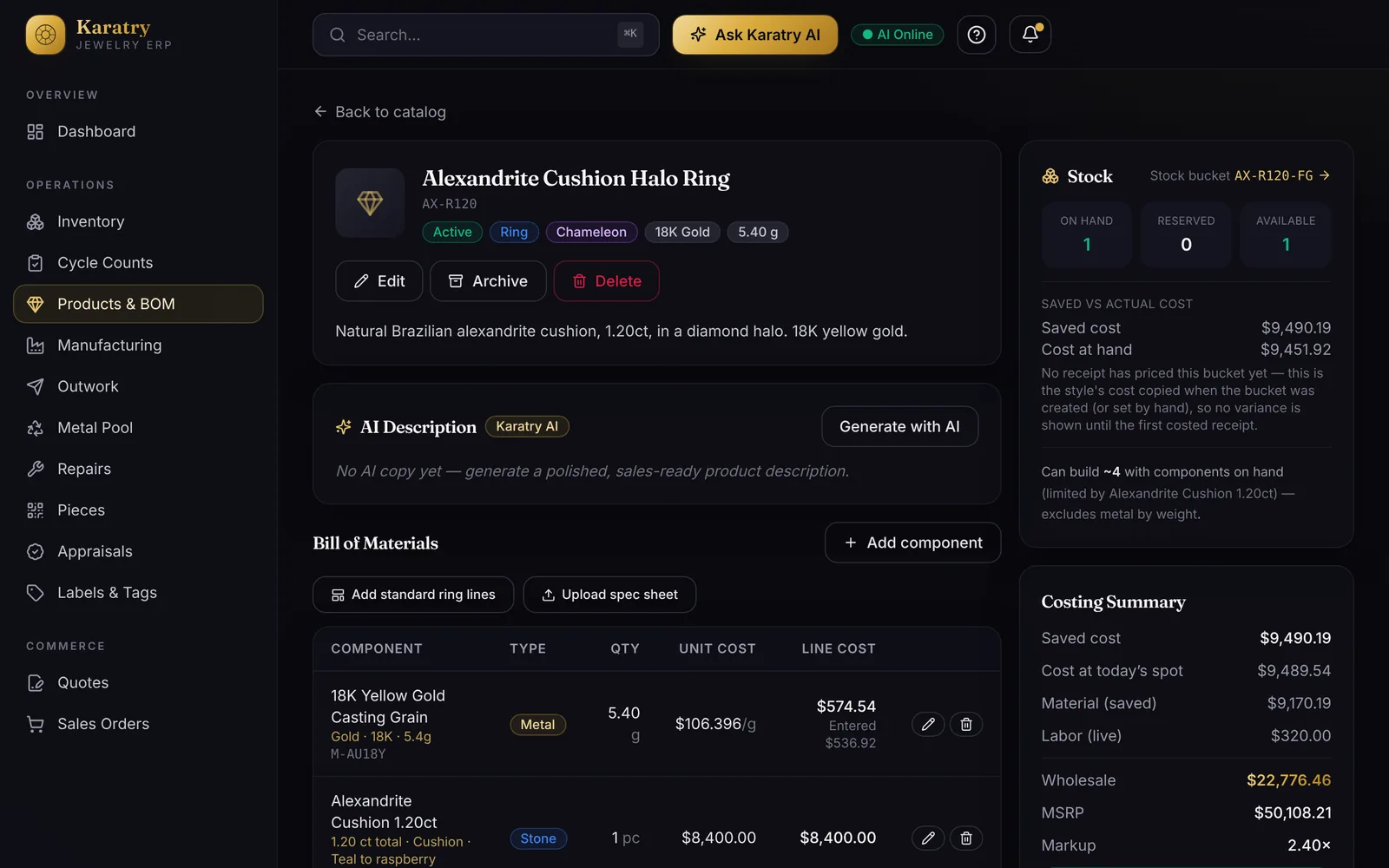
A style's bill of materials and its costing summary. The style in it is made up.
A jewelry bill of materials, step by step
- Start the style. A starter template adds the usual lines for a ring, bracelet or earrings at $0, ready to fill in. Or upload a spec sheet as a photo, PDF, CSV or Excel file, and Karatry AI drafts the lines. Nothing is saved until you confirm.
- Add the metal. Pick the metal, karat, color and form: casting grain, wire, sheet, solder, tube, strip or chain stock. Enter the weight in grams. A two-tone piece gets one metal line for each metal, each at its own karat.
- Add the stones. A center stone carries its shape, color, clarity, cut, carat weight and certificate, priced per carat. Melee goes in by sieve size and stone count.
- Add findings, labor and stone setting. Findings have their own list: clasps, jump rings, posts, ear nuts, bails, bezels, prong heads, chain and more. Labor lines name a bench step, such as Cast, Set, Polish or Rhodium, so stone setting is costed like any other step. Each step has your shop's rate per piece, and a labor line with no cost of its own uses it. Outwork and plating go on as service or labor lines.
- Read the price. Cost to make adds up metal, stones, findings, materials, labor, services and duty. Wholesale is cost times the style's markup. New styles start at 2.4×. MSRP is wholesale times 2.2.
Save the components you use often and reuse them on any style. Import duty can go on one line or on the whole style. You choose whether duty is marked up or passed through with no markup.
Gold jewelry cost by the gram
Karatry costs metal from the weight, the purity and today's spot price. Then it adds the style's metal loss. New styles start at 8% loss, and a metal line can carry its own. Scrap recovery is the share of that loss you get back from refined scrap. It starts at 0%.
The math for one metal line:
grams × purity × (spot per troy ounce ÷ 31.1035) × (1 + loss % × (1 − recovery %))
Say a band takes 5 g of 14K, and gold is $4,000 a troy ounce. 14K is 58.5% gold. With 8% loss and no recovery, the metal costs 5 × 0.585 × ($4,000 ÷ 31.1035) × 1.08 = $406.26. The style page shows this math with your own numbers in it, so you can check the metal figure by hand.
To find your real loss from your own weights, try the free gold metal loss calculator.
Your diamond price book
The price book belongs to your company. Each price is a cost per carat for a sieve size and quality, with the date it takes effect. Karatry uses the latest price dated on or before today. A price dated next month waits for its date.
On a melee line, pick a sieve size, a quality and a stone count. Karatry fills in the total carats from its sieve chart and the cost per carat from your book. If you type the vendor's real parcel weight instead, Karatry keeps your number and shows the chart figure beside it.
Melee quality runs VVS, VS, VS1, VS2, SI, SI1, SI2 and I1. You can add your own sizes outside the chart, like +0000 or 1/5. The price book imports from a CSV. Set a diamond markup and Karatry shows a sell price per carat beside cost. Costing always uses cost. Each stone line also records its origin: natural, lab-grown, simulant or treated.
Look up any size in the free diamond sieve size chart.
Updating prices when the gold price changes
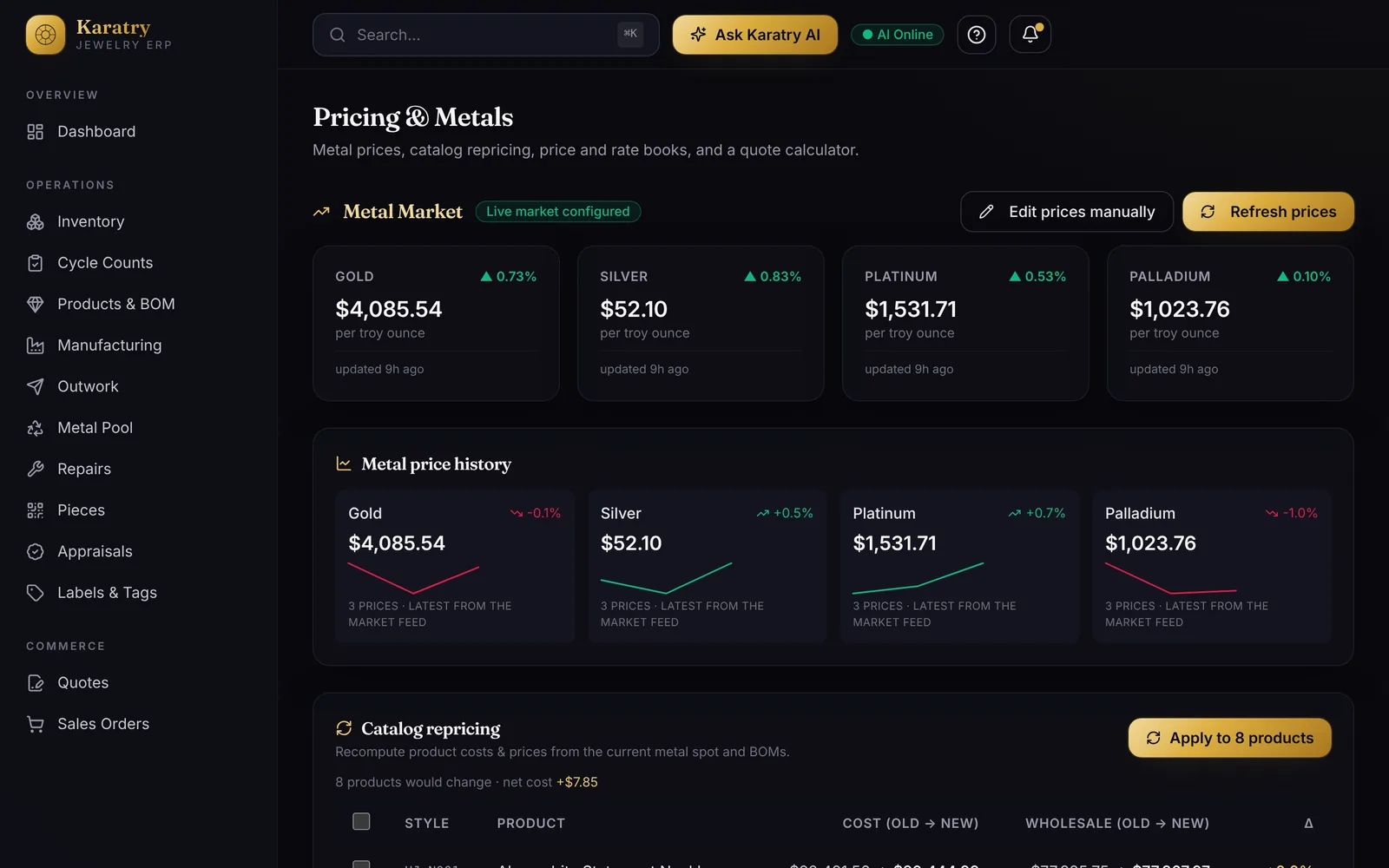
Pricing & Metals: spot prices, their history, and a catalog reprice you check before you apply it.
Karatry fetches spot prices for gold, silver, platinum and palladium every weekday morning. You can press Refresh at any time, or type a price yourself. Every change goes into a price history.
A refresh never re-costs a style. Pricing & Metals lists the styles whose metal moved past your re-cost threshold, and by how much. The threshold starts at 7%. When you are ready, press Re-cost and confirm. Karatry rewrites cost, wholesale and MSRP at today's metal prices and labor rates. Parts lists don't change.
To bring your wholesale catalog up to date, catalog repricing previews each style's old and new cost and price. Tick the styles you want and apply them. Karatry saves a restore point before a bulk re-cost or reprice, so you can roll it back. Quotes, published line sheets, orders and invoices keep their own prices. Nothing re-costs them.
What it replaces
Karatry replaces the costing spreadsheet. Spot prices, your diamond price book and your labor rates sit in one place, and every style reads from them. You can switch off who sees cost, margin and vendors, role by role.
The same system runs memo and consignment and the bench. See every feature, or compare Karatry with what you use now.
What it costs
Costing is part of the one plan, Professional. It is $30 a seat a month, or $300 a seat a year. Every seat includes $10 of Karatry AI a month, shared across your workspace. Try everything free for 30 days, with no credit card. See pricing.
How to move over
Import your styles by style number from a CSV, with your customers and inventory, in minutes. Parts lists don't come in by CSV. Upload a style's spec sheet instead, and Karatry AI drafts the parts list for you to check. If you get stuck, a real person answers email support. Your data exports to CSV at any time, and there is no exit fee. See how switching works.